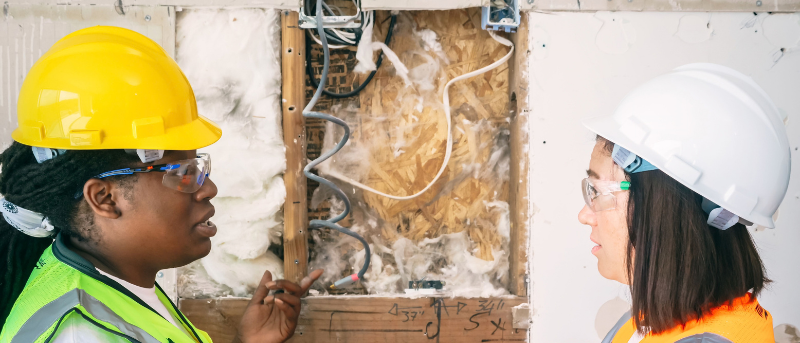
To mark International Day of the Girl this week, we celebrate the girls who will become tomorrow’s engineers, project leaders and decision-makers.
In this personal reflection, EAP Board Member, Catherine Barnett-Jaafar, shares how an unexpected question early in her engineering career shaped her thinking about why diverse perspectives lead to better infrastructure – and why understanding the people we design for is just as important as the engineering itself.
By Catherine Barnett-Jaafar, Board member, Engineers Against Poverty
I was the youngest person in the room; the only woman; and the most junior by far, when out of nowhere, I was rather incredulously asked by a male, mid-forties, white client: “do women ACTUALLY use a backlit mirror to apply their makeup?”
I remember two things about that moment. The first: everyone looking at me keenly, including the supplier (a man) who had dared to suggest such a thing and was making it very clear from his body language he expected me to say yes.
The second, and most definitely more powerful(!): whilst I personally had never used such a thing, this was the first time in my nearly 2-year career, that anyone had even thought to ponder whether a women might value slightly different things, and that therefore a woman’s opinion should be sought for consideration by decision-makers.
That moment taught me something that has stayed with me throughout my career: good engineering is not just about technical excellence – it is about understanding the people we are designing for and ensuring they are involved in decision-making about them.
Through this process, I got to be part of a decision that proved a point made by a lecturer in my first year at university: we are not here to build a bridge for the sake of the bridge. It does not matter how pretty the bridge is; what matters is that it is safe and it meets the needs of the local communities on both sides of the bridge. That means the bridge should provide a route that improves access to health care, education, clean water and power, and faster access to markets to enable people to feel richer.
A mirror will never be a bridge. But at the heart of my lecturer’s challenge (and later the client’s question) was: where does material functionality end, immaterial functionality begin, and who determines those?
In all honesty, after all this time, across multiple sectors and geographies, I remain unconvinced we have both understood this question and know how to answer it. But what I have observed through my 20+ year career is the projects who fail to answer this question either at all or at the right moment for the project, are also the ones who struggle to govern and control the project appropriately, contending with both over- and under-specification, significant in-flight change, spiraling costs, and challenging relationships. Most often referred to in our industry as ‘gold plating a tap’ – sound familiar?
Candidly, the answer to this question comes much earlier than most realise. For a project to be successful, it needs to start on the first day of project initiation and evolve as the project matures through the design phases.
I spend much of my working life helping client organisations and asset owners understand why they are making this significant and risky investment. A critical part of those early conversations is understanding whether a project is being initiated to mitigate a risk, realise an opportunity, or, more commonly, both. And that gets to the purpose of the project – what are you trying to achieve.

Going back to the bridge example, who do you want to move, from where, and why? At no point in those early discussions has a decision been reached that a bridge is the right answer.
Helping clients to focus on the who do you want to move and why enables local (and sometimes regional) communities (or beneficiaries) feel part of a solution which means they are more likely to be both able and willing to use it. They are therefore fundamental to determining the line of where material becomes immaterial functionality. But critically, they are not the only group.
Establishing what potential solutions exist and how these will operate opens up another group – the ‘Operators’. Again, they are key to determining what constitutes material versus immaterial functionality.
The client is responsible for defining the purpose of the project and bringing together the perspectives of beneficiaries and operators. Designers and builders then translate those requirements into reality. Successful projects depend on these groups working together to agree where functionality should begin and end. The ‘users’ and ‘operators’ – who often come together through a Project Sponsorship function – must work alongside the ‘client’ and later ‘designers’ and ‘builders’ to collectively agree where to draw the line on material and immaterial functionality – and it is always hard.
Yet even when these conversations happen well, there is another challenge.
We know that collectively asset intensive owner organisations, operators, designers and builders are not representative of the users. We are designing out – unintentionally – whole sections of society because of an unrepresentative workforce.
Go back to the mirror example at the start – I was the only woman in the room, and I did not, personally, see the need for a backlit mirror. But I am one woman. I cannot and do not speak for every woman on Earth – and nor do I want to – and yet in that moment I was expected to speak for a collective group. At no point was there any acknowledgement that each woman is unique with different needs and expectations.

We do need to think about how what we design, and build serves a greater number of parts that make up a population – and I don’t mean percentage. Engineering remains a heavily male-dominated profession. As a result, many design assumptions are unconsciously shaped by the experiences of men rather than the diverse needs of the people who will ultimately use the asset.
Years later, another project reminded me just how easily assumptions become embedded in design. We were designing a public space venue, where we invested significant time and money debating how many toilets for each gender would be provided in the eventual facility, settling for equal numbers with the team priding themselves on how ‘inclusive’ they had been.
As I suggested to the room, it is well documented that, on average, more time is taken in a woman’s bathroom so we should take that into consideration in our design principles. Later adaptations were introduced to combat the queues outside the women’s bathrooms, because guess what, there was simply not enough capacity allowed for in the permanent solution.
And the worst part: there is a pride around having problem solved using an adaptation that, in this case, gives women access, but the temporary solution is not a pleasant experience, which raises the question of are the women willing to use the facility? I doubt it.
Having a truly representative workforce is phenomenally powerful. On international day of the girl it is a powerful time to remind ourselves that we need to attract girls early into the industry, and then as they become women support and retain them, and ensure they have role models and allies. Because without them, we are going to struggle to ensure that the largest possible group of beneficiaries, users and operators are not just able, but also willing to use the asset is the goal – and doing so in the most efficient, effective and valuable way ultimately delivers success.
And in case you were wondering… the women got their backlit mirrors!
 Catherine is a leader in Ernest Young’s UK&I Sustainable Infrastructure team leading social infrastructure. She brings over 20 years of experience in advising on multi-billion-dollar infrastructure projects around the world, including eight years in the Middle East. In her career, she has worked across a wide range of sectors: social infrastructure (and place-making programmes), transport (roads, rail, ports and airports), energy and energy transition, and defence. Catherine is a graduate of the University College London in Project Management for Construction, and is an active member of both the Major Projects Association Programme Committee and the Infrastructure Diversity Charter, launched by the National Infrastructure Commission in February 2025.